Tsukuyomi: Moon Phase – Over 20 Years of Furufuru Moon
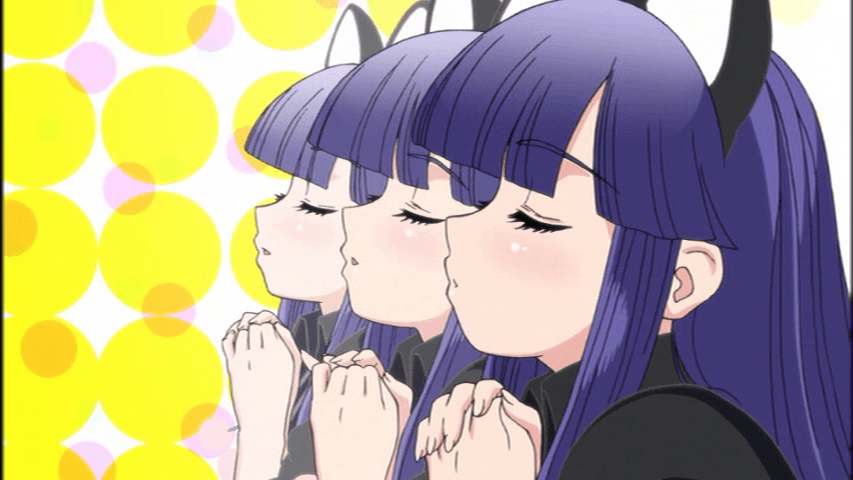
As it’s been a while since I’ve written about the man, I would like to remind everyone about a key fact central to my personality: I like the anime director Shinbō Akiyuki. In fact, the second review I ever published on this blog was a review of one of his old OVAs! I will admit to falling off of avidly following his work early on in the 2010s aside from the Monogatari series[1]And now, I’ve even fallen off of Monogatari–I’ll catch up, eventually., as I wasn’t particularly a fan of Madoka, and the other projects he was attached to later in his career failed to capture my interest. That said, as the man is now near retirement age, his output has also decreased significantly in the past decade, especially compared to the mid-to-late 2000s, where he was on multiple shows per season. So all said, I don’t think I’ve missed much.
What I’m trying to say in so many words is that I really enjoy Shinbō’s early collaborations with studio SHAFT that dropped in that crazy, Wild West time of the mid-to-late 2000s. During that period the man cooked, and cooked well. While in past years I’ve gone back and watched works like Sayonara Zetsubō Senseiand Pani Poni Dash, while also keeping up with Monogatari in the theater[2]…which I suppose was a decade ago., it had been a while since I dipped back into their first magical collaboration: Tsukuyomi Moon Phase. Hell, I think I’d only ever seen it through to the end once.
This changed in late 2024, when I was inspired by a stray post on the internet, and started my journey back through Tsukuyomi. Work introduced some delays into this revisit, and further life setbacks delayed the writing of this post, but now since I have some time on my hands, I’d like to share some observations I had while watching Tsukuyomi over 20 years since its airing, and a decade and much change since I first saw it on DVD. If you haven’t seen the show, perhaps read the summary here to ground yourself.
Anyway, onwards to my extremely insightful observations!
Hazuki is Cute!
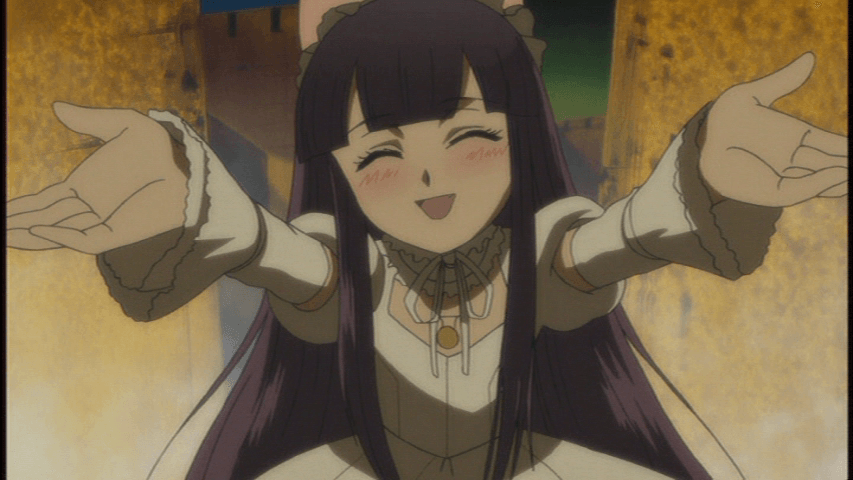
First things first–Hazuki is still damn cute. While I wasn’t a member of the Church of Tsundere back in the day, Hazuki is certainly one of the characters that made me consider converting[3]Unfortunately, a glut of low-quality tsundere ultimately put me off.. Her stand-offish attitude towards Kōhei comes off as very natural, and characteristic of the child that she is. It also helps that Kōhei is just a dense dumbass, so a lot of Hazuki’s temper-tantrums feel warranted.
Also, Hazuki is a more classic tsundere, who transitions over time from being stand-offish to more friendly, rather than erratically code-switching like many mass-produced tsundere were want to do. During her time at the Midō home, her integration into the family unit feels organic, offering clear plot reasons for her changing attitude. Once the big finale is said and done, she does revert back to being quite tsun-tsun–which does feel a bit played out–but on the whole she’s a great, well-developed character.
Of course, I have to give props to Saitō Chiwa for breathing extremely convincing life into the character, in what is quite an early role for her. While Hazuki has a super cute design, she would be nothing without Saitō’s relatively humanistic portrayal of the young vampire. This isn’t to say that Tsukuyomi doesn’t fall back on anime cliche in its acting, but the interplay amongst the cast has a vibrance to it that elevates the characters, and Saitō certainly pulls her weight there.
Transition from the Classic Shinbō Style to the SHAFT X SHINBŌ Aesthetic
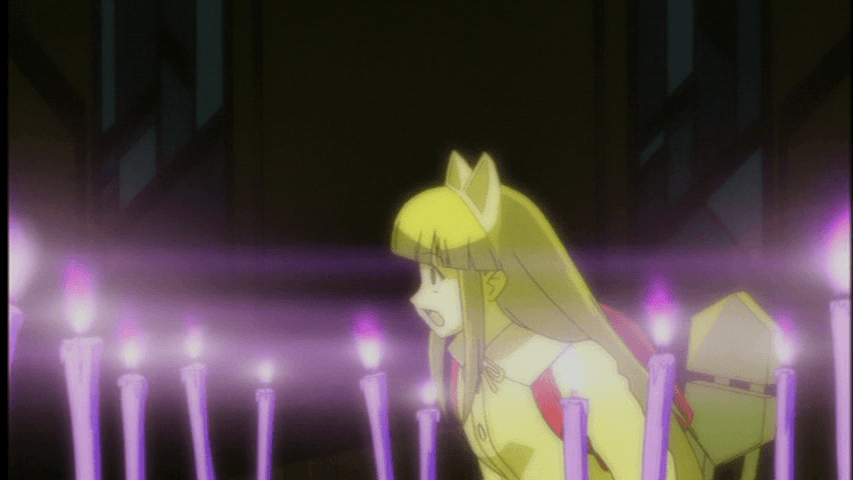
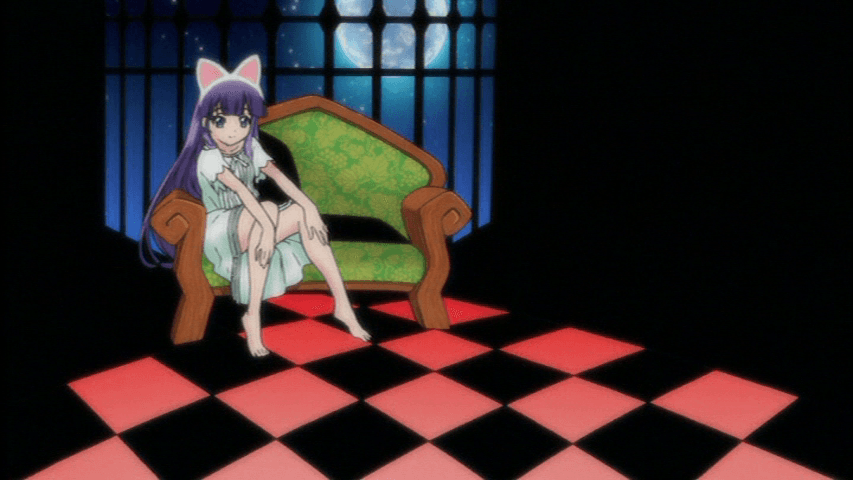
As mentioned earlier, Tsukuyomi is the first collaboration between Shinbō and SHAFT, and the shift in tone throughout the series clearly illustrates a transition in style. The first half of the show is deep in the classic Shinbō style, with scenes bathed in dark shadows, stark colors, and at times complemented by heavy deployments of avant garde patterns in the background if the setting demands it. And while these early episodes certainly have funny moments–they’re already dropping washpans on folks left and right, a series trademark–the approach prioritizes amplifying drama, establishing a tone of mystery, and setting up for sick action. And boy, the action! It can truly sing in the first half. While there’s not heavy heapings of it, what we get is dynamic, stylish and cool. I always find myself going back to the first big assault on Count Kinkel in episodes 8 and 9–specifically this small skirmish between Ryūhei and the Count. There’s also the final showdown between the Midō family and the Count mid-season, which is heavier on the dynamic and artistic imagery, but is still extremely imaginative, and has some solid action animation.
As Tsukuyomi progresses into its back-half, it maintains key elements of its mysterious and dark aesthetic, but the classic elements of the Shinbō style start getting toned down. As a result, the show starts to look more like a “normal” early 2000s anime–but at the same time, the slapstick comedy ramps up. Most prominently, otherwise dramatic scenes are deliberately undercut by the aforementioned falling washpan gag. By the end, during the main climatic action scene, SHAFT doesn’t miss a beat in slamming the pans on each characters’ head after they do their cool moves. Needless to say, it gets quite goofy.
The final TV episode acts as something of an epilogue, showcasing some nice organic character humor in a long-form fashion, while also mixing in some solid human drama. Meanwhile, in the DVD-only extra episode, the character designs have already shifted to those of Pani Poni Dash, and the tone and rhythm is more in tune with that series[4]I assume they were made at the same time., which perfectly completes this transition from the classic Shinbō style to what I like to call the SHAFT X SHINBŌ aesthetic.
Lastly, I would be remiss not to mention the completed ending sequence, and how it’s complete fire. It’s got the classic stylish Shinbō nonsense I love, packed into a tight 90 seconds. That said, credit should go where it’s due–the guy who helmed the ending was Tsukuyomi’s assistant director, Suzuki Toshimasa!
Elevated Artistry
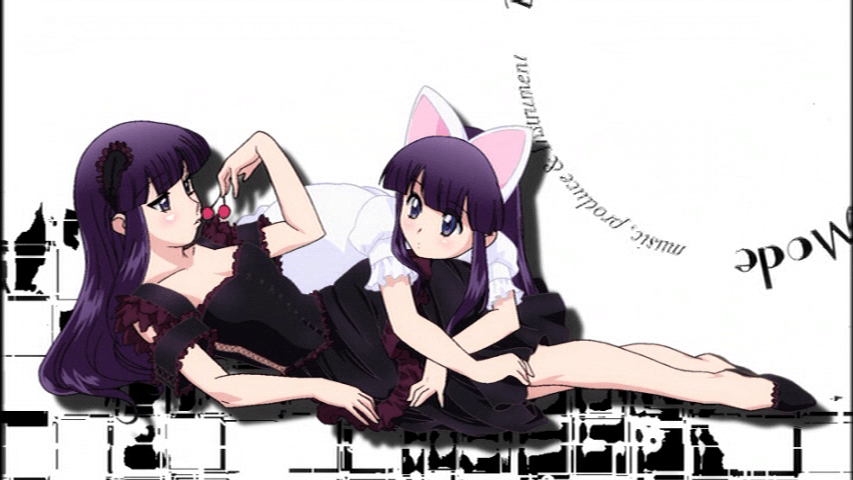
Tsukuyomi is a rare case in which I far prefer the artwork of the anime adaptation versus that of the original manga. The manga designs are too generically moe for me, in a very simplistic late-1990s/early-2000s way that doesn’t especially live long in the memory. Meanwhile, Aizawa Masahiro’s take on the cast mixes in traditional anime deformations with a measured tendency towards realism. While Arima Keitaro’s artwork is quite flat, the characters rendered by Aizawa’s pen have concrete volume, coming to life in a distinctly rounded, and somewhat plump style that would go on to define SHAFT’s style early on in their emergence as a major studio[5]That said, Tsukuyomi was the last work Aizawa worked on with them.
To put on my Pervert Hat for the first time in a while, it goes without saying that this approach does wonders on the female characters. The ladies in Tsukuyomi all have large round eyes, perky lips, and their bodies are rendered with a sensual realism. Of note, what stands out about SHAFT’s mid-2000s work is their attention to detail when it comes to hair–all the women in the show have very detailed hairstyles, with strands of hair realistically draping over them as they move. Zooming in even further, close-ups of characters are typically keen to show individual eyelashes, further contributing the show’s mix of realism against a deformed anime aesthetic. When it comes to costumes, it’s clear the staff was obsessed with Hauzki’s outfits, which are all cute, detailed, and change regularly for a majority of the show’s run. Meanwhile, Aizawa doesn’t cut corners on the male cast either–I feel Count Kinkel is underrated as one of anime’s cooler looking villains, and Ryūhei is certainly up there as one of anime’s top “uncle grandfather” characters with his slicked-back gray hair and weathered face.
Of course, all of my comments apply to the characters when they are on model. I have only ever seen the home video version of the show[6]I hear the broadcast version was a mess., and in general it looks quite clean for a show of its vintage, but the artwork does falter in some cases, and you certainly see individual styles come through regularly. On the whole though, the character designs represent a clear transition from 1990s to 2000s aesthetics, mixed with SHAFT’s predilections of the time.
Before closing off this section, I’d like to take a quick look at the show’s backgrounds. While the rendering of locations in Tsukyuomi is in general quite typical of anime of the time, the first part of the series set in Tokyo at times excels at depicting dark and moody scenes. As someone who likes to take a lot of nighttime walks through Japanese suburbia, the establishing shot of the Midō household at night is striking and immersive. And while this is quite early on in the show, the aforementioned avant-garde look of the art museum Count Kinkel uses as his stronghold is simply awesome.
Boy do I Miss 2-Cour Series
Lastly, I’d like to make a short note on Tsukuyomi’s length. To me, the 2-cour 24~26-episode TV series is the perfect form of anime. You get enough time to tell a good story, but you also have enough time for diversions to let things breathe, and there’s less risk of wearing out your welcome like there is with a year-long series. Despite being a series about a cute teenage vampire girl with cat ears, Tsukuyomi’s story progresses at a decent clip and comes together nicely, while also sure to mix in vignettes that give the cast solid development. I will admit that the final arc in Kyōto is a bit too long, but I prefer that over something like–let’s say G-Quack, to dish out a recent example–that may feel a bit too compressed and rushed. Tsukuyomi even has enough time for a full-episode epilogue that just has the cast chilling–anda stupid DVD-only gag episode that looks like Pani Poni Dash, as mentioned earlier.
My intention for this post was to have it be a “light” look back at this quirky old series, but it seems like I easily busted out over 1,800 words. Ah well! Anyway, one day I may “properly” review this series, including a look at the original comic. But for now, these are my scattered thoughts. If you haven’t seen Tsukyuomi in a while–or hell, if you haven’t seen it at all–it’s a great example of anime’s shift into the moe aesthetic in the early 2000s, but has a solid story, fun characters, and cool artistic sense that puts it a cut above other offerings at the time. I think it’s a good time![7]I’ve danced around this, but I’ll drop this in a footnote…do note that the show is also complete lolicon bait. So be ready for that!
Notes
| ↑1 | And now, I’ve even fallen off of Monogatari–I’ll catch up, eventually. |
|---|---|
| ↑2 | …which I suppose was a decade ago. |
| ↑3 | Unfortunately, a glut of low-quality tsundere ultimately put me off. |
| ↑4 | I assume they were made at the same time. |
| ↑5 | That said, Tsukuyomi was the last work Aizawa worked on with them |
| ↑6 | I hear the broadcast version was a mess. |
| ↑7 | I’ve danced around this, but I’ll drop this in a footnote…do note that the show is also complete lolicon bait. So be ready for that! |
Glad you’re still about, somehow, somewhere.
You know it